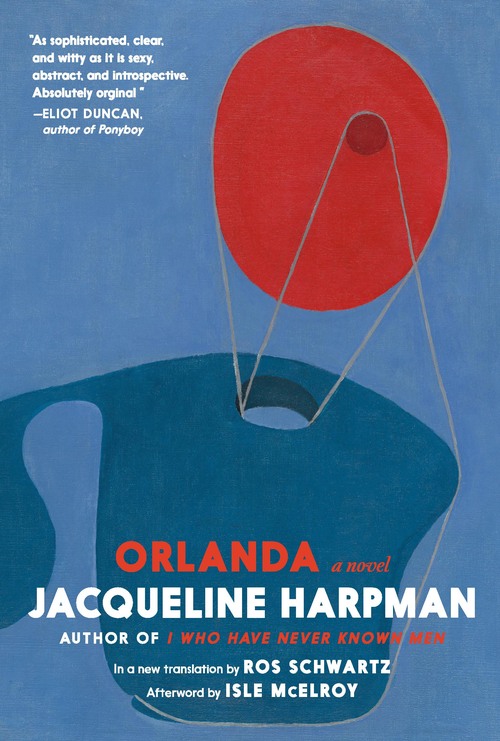
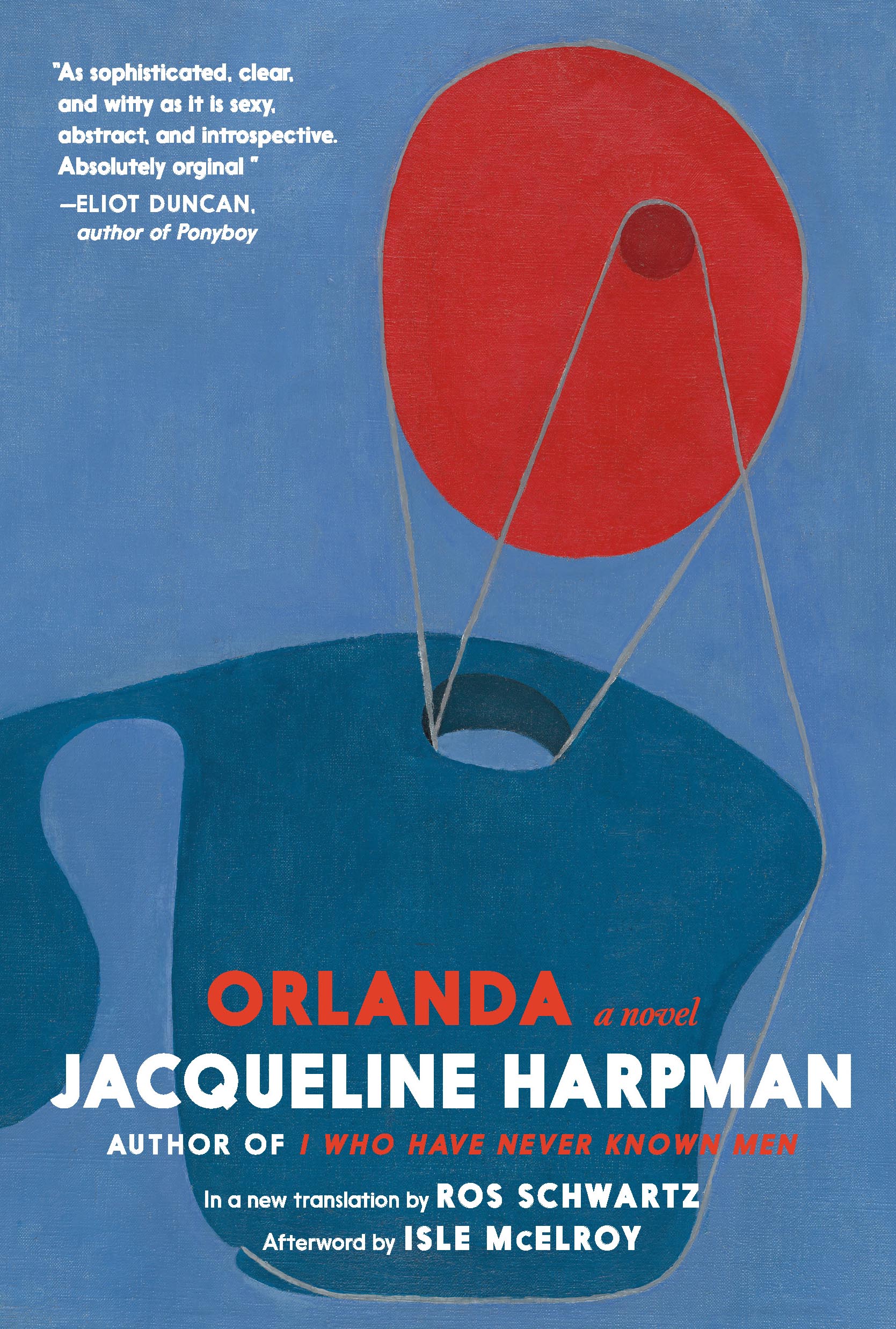
From the author of I Who Have Never Known Men, a groundbreaking novel about a woman whose subconscious mind splinters and finds itself in the body of a young man.
Now in paperback with a new afterword by Isle McElroy for the 30th anniversary of its original publication.
One afternoon in a café across the Gare du Nord train station in Paris, Aline Berger, a literature professor, struggles to re-read Virginia Woolf’s Orlando, when an odd feeling comes over her. Suddenly, part of her consciousness splits off and finds itself in the body of an attractive young man named Lucien Lèfrene, who works as a rock journalist. In this newfound body, Aline’s splintered mind names themselves Orlanda in homage to Virginia Woolf as a woman who has now become a man.
Orlanda begins to follow Aline. And when the two meet again in Belgium, Aline subconsciously sheds her prim tendencies for a more assertive presence, as she begins to understand that Orlanda was born from her own psyche. Orlanda is the assertive, confident, and amorous person, who loves men unabashedly, that Aline has always aspired to be but could never become. The more time the two spend together, the less time they can stand to be apart.
Jacqueline Harpman's lyrical novel is a stunning portrait of a woman who is forced to confront every part of her soul and embrace herself fully.
Other books we recommend


Isle McElroy’s Afterword to Orlanda by Jacqueline Harpman, tr. Ros Schwartz
Isle McElroy’s afterword to the 2025 edition of Orlanda: A Novel by Jacqueline Harpman, translated from the French by Ros Schwartz. Now available from Seven Stories Press.
Afterword by Isle McElroy
The restless, demoralized quality of life under fascism was ingrained in Jacqueline Harpman from an early age. Harpman was born in Belgium in 1929, but her family fled to Morocco to escape the Nazis at the beginning of World War II and did not return to Belgium until after the war. Escape is a common theme in her fiction—at least, in those books of hers translated into English by Ros Schwartz. The impact of both the dictatorship that spurred her exile and the rupture of her leaving home at such a young age is apparent in one of her most popular books, I Who Have Never Known Men. The novel follows a group of thirty-nine women who wake up imprisoned in a bunker, with no memory of why they’re being held captive; they are kept alive by a crew of male guards who sporadically deliver them meals. When the women eventually escape, they find the outside world mystifying and desolate, full of similar bunkers where prisoners have died in captivity. I Who Have Never Known Men is a bleak tale about the unique threats of imprisonment and freedom, a novel in conversation with other feminist dystopian works, like Margaret Atwood’s The Handmaid’s Tale and Octavia Butler’s Parable of the Sower. Before writing this slim novel about living through a misogynistic dystopia, however, Harpman published the quieter, more fantastical novel Orlanda. Unlike I Who Have Never Known Men, where imprisonment and escape are literal actions undertaken by characters, Orlanda approaches those topics from a metaphorical—and at times a metaphysical—angle in order to explore the psychological impact of misogyny and repression on women.
Orlanda, winner of the 1996 Prix Médicis, makes no attempt to hide its debt to Virginia Woolf’s Orlando. Harpman’s novel opens with a thirty-five-year-old literature professor, Aline Berger, rereading Orlando at a train-station café in Paris in preparation for a seminar she teaches. But Harpman is not writing an ode to Woolf. Rather, Aline is only rereading Orlando out of an obligation to teach the book in her seminar. She would rather crack open the sci-fi novel she has tucked in her bag. Harpman is both indebted to Woolf and attempting to move beyond the celebrated author—she’s writing nearly seventy years after Woolf first published Orlando—for she understands that what served as a challenge to gender norms in 1928 won’t work in 1996. Though Harpman wrote Orlanda in the midst of feminism’s third wave, the book is relatively quiet on some of the era’s primary concerns, like sexual harassment and workplace equality. Instead, Harpman focuses her attention on the psychological impact of gender discrimination and misogyny.
In Orlanda, Aline is bored with her life. Unmarried, she lives with a man out of inertia and convenience; she long ago stopped finding him handsome. She believes herself happy but is severely depressed. This has Betty Friedan written all over it. Harpman, a psychotherapist, brilliantly reimagines this kind of late-century ennui through psychological means. Aline is depressed in large part because she’s been repressing her inner spirit since she was twelve. That spirit—whom Harpman names Orlanda—represents Aline’s masculine counterpart. He is aggressive, confident, and unbelievably horny. Prior to Aline’s train ride, Orlanda gains corporeality when he spies an attractive, young rock journalist named Lucien Lefrène and then wills himself out of Aline’s body and into Lucien’s. 235
Here is where Harpman makes her separation from Woolf most apparent. Whereas, in Orlando, Woolf sought to chart the duality within a single person, in Orlanda, Harpman instead wishes to show why that duality struggles to exist. Set free from Aline, Orlanda experiences a kind of freedom he didn’t know existed when he was entwined with his previous host. Harpman’s interest in the themes of imprisonment and escape are made manifest through the character of Orlanda, and in this way, the book lays the groundwork for these theme’s more literal expression in I Who Have Never Known Men. Orlanda is direct in treating his previous existence, Aline’s repressed masculine energy, as a form of imprisonment. On his own, he achieves an authentic self, pursuing desires that Aline never even considered.
But for Harpman, the erotic charge of the book is less about the union of bodies than it is about the discovery of desire. And the pursuit of desire is tantamount to the pursuit of freedom. What stands out in these passages is not what Orlanda is up to but how Harpman details the scenes. She evokes Orlanda’s escapades with a cheeky, self-conscious modesty that feigns respect for Woolf. Her modesty feels especially curious to a reader in 2025. It occasionally reads like an unnecessary performance—were people really so prudish in the ’90s?—but through it, Harpman calls attention to the way characters perform their roles in the text: Aline as a professor and girlfriend, Orlanda as a toxic boyfriend. The most explicit performance is, unsurprisingly, how these two main characters express their genders. At times, Harpman’s views on gender does capitulate to a frustrating gender essentialism that sees something inherently sexual and free in Orlanda and something demure and sacrificing in Aline. But, this kind of essentialism is necessary to the body-swap trope.
Though Orlanda is not technically a body-swap novel, it borrows from the moralizing impulse traditionally expected of body-swap stories. These stories commonly act as empathy parables, where characters are forced to reckon with how the other half lives. From Mark Twain’s 1881 novel, The Prince and the Pauper, to the 2003 film adaptation of Freaky Friday (loosely based on Mary Rodgers’s 1972 children’s book), body-swap stories force characters to gain a deeper understanding of people whose lives are far distant from their own. Freaky Friday, for instance, forces a mother and daughter to empathize with each other’s plights; when these stories force characters to swap genders, it often results in reductive narratives where men finally see how hard life is for women.
Unsurprisingly, this genre of story is also ideal fodder for erotic writing—a great deal of trans erotica centers on body swaps, including many of the texts I read before coming out. Body-swap stories tend to pick a side—they’re either erotic or chaste—but Harpman slyly situates her novel between the moralizing and the erotic. Orlanda is excited by his new body because Aline would be excited by his body. I’m reminded of Andrea Long Chu’s essay “On Liking Women” where she argues for the simple urgency of longing for femininity as an important part of transitioning. Does Orlanda’s excitement in Lucien’s body make him trans? No, it doesn’t. But it leaves space for an erotic understanding of the self that feels very modern, a sexualized self-love that has become increasingly popular on social media.
Impressively, Harpman not only pins her book between the erotic and the empathetic— she also complicates her characters’ expectations of empathy. Orlanda discovers a great deal about Lucien; this does not, however, lead him to care more deeply for Lucien, as one might expect from a character in a body-swap story. Similarly, as Aline grows closer to Orlanda, she comes to resent the dynamic expression of herself. There is something cunning and malevolent about how the novel proceeds. Harpman does not moralize about understanding the other. Rather, Aline takes advantage of Lucien’s otherness to deepen her relationship with the parts of herself that are antisocial and cruel. By the end of the novel, she accepts those parts of herself she once worked so hard to reject.
Though Orlanda does not, like I Who Have Never Known Men, directly address the global creep toward fascism and dystopia, it accomplishes something more nuanced and, at times, more compelling: the difficult question of how to deal with the problem of being a person. It is a novel of freedom and transformation that refuses to moralize. It is honest in its portrait of envy and desire, in tracing the unsettling addiction a person can have to themself, an arc that feels like a literalization of our contemporary obsession with our social media selves. This is the genius of Harpman’s work: she deftly makes literal the abstractions that shape our lives. What would it look like to give space to the parts of ourselves we’ve been repressing? Her answer—which feels especially radical in an era of personal growth and hyper-psychologizing—is something of a cautionary tale. The problem is not that you might not like what you find. Rather, you might like it a little too much, you might continue embracing that self, to the detriment of the life you were already living.
ISLE McELROY’s debut novel, The Atmospherians, was named a New York Times Editors’ Choice. Their second novel, People Collide, was named a best book of 2023 by Vulture, NPR, Vogue and was a New York Times Critics’ Pick. Their third novel, Satellite, will be published by Viking in 2027. Other writing appears in The New York Times, New York Times Magazine, Vulture, The Cut, The Atlantic, Esquire, and elsewhere.
From the author of I Who Have Never Known Men and We Were Forbidden, Orlanda is a groundbreaking, exquisitely funny novel about a woman whose subconscious mind splinters and finds itself in the body of a young man.
Now in paperback with a new afterword by Isle McElroy for the 30th anniversary of its original publication.
One afternoon in a café across the Gare du Nord train station in Paris, Aline Berger, a literature professor, struggles to re-read Virginia Woolf’s Orlando, when an odd feeling comes over her. Suddenly, part of her consciousness splits off and finds itself in the body of an attractive young man named Lucien Lèfrene, who works as a rock journalist. In this newfound body, Aline’s splintered mind names themselves Orlanda in homage to Virginia Woolf as a woman who has now become a man.
Orlanda begins to follow Aline. And when the two meet again in Belgium, Aline subconsciously sheds her prim tendencies for a more assertive presence, as she begins to understand that Orlanda was born from her own psyche. Orlanda is the assertive, confident, and amorous person, who loves men unabashedly, that Aline has always aspired to be but could never become. The more time the two spend together, the less time they can stand to be apart.
Jacqueline Harpman’s lyrical novel is a stunning, remarkably comedic portrait of a woman who is forced to confront every part of her soul and embrace herself fully.

JACQUELINE HARPMAN (1929–2012) was born in Etterbeek, Belgium. Her family moved to Casablanca to avoid persecution when the Nazis invaded, and returned home after the war. After studying French literature Harpman began training to be a doctor, but became unable to complete her medical studies after contracting tuberculosis. She turned to writing in 1954, and her first book was published in 1958. In 1980 Harpman qualified as a psychoanalyst and continued to practice throughout her life. She had given up writing after her fourth book was published in 1966, and resumed her career as a novelist only some twenty years later. Harpman wrote over 15 novels including I Who Have Never Known Men, and won numerous literary prizes, including the Prix Médicis for Orlanda.
Over the past forty years, award-winning translator ROS SCHWARTZ has over a hundred works of fiction and nonfiction to her name, from writers such as Tahar Ben Jelloun, Andrée Chedid, Aziz Chouaki, Fatou Diome, Dominique Eddé, Georges Simenon and Simone Weil. Her new translation of Antoine de Saint-Exupéry’s The Little Prince was published in 2010 and shortlisted for the Marsh Award. In 2009, she was made a Chevalier dans l’Ordre des Arts et des Lettres. A Fellow of the Institute of Translation and Interpreting, she was awarded the 2017 John Sykes Memorial Prize for Excellence.