July 05


A guide to direct action for those disillusioned with the posturing of liberal “activism.”
The left is losing, but it doesn’t have to be that way. Here is the radical’s guide to activist work—the manual we need at this crucial moment to organize for universal human rights, a habitable earth, and a more egalitarian society.
In Volume 2: Actions and Strategies for Change, McBay uses the successful strategies of various actions, such as the Greek Resisters of the 2008 Greek Television Takeover, to articulate the best practices for inter-activist coordination and communication with mass media to effectively spread message.
Thoroughly exploring the achievements and failures of radical movements throughout history—from 19th-century anti-colonial rebellions in China and the environmental actions of First Nations and Native American tribes throughout the 20th century, to Black Lives Matter and the fight for Gay Liberation—the two volumes of Full Spectrum Resistance candidly advocate for direct action, not just risk-averse models of protest marches and call-ins. With in-depth histories and case studies of social justice and environmental movements, noted writer, activist, and farmer Aric McBay explains why passive resistance alone cannot work, and how we must be prepared to do whatever it takes to create substantial social change.
In Volume 2: Actions and Strategies for Change, McBay uses the successful strategies of various actions, such as the Greek Resisters of the 2008 Greek Television Takeover, to articulate the best practices for inter-activist coordination and communication with mass media to effectively spread message. Covering reconnaissance methods and other forms of intelligence-gathering, Volume 2 guides the reader in smart decision-making and damage control, such as how to recover from both covert and overt adversarial attacks, such as COINTELPRO (1971). Moreover, this manual clearly articulates the best strategies and practices for the financial, logistical, and tactical organization necessary to all successful radical movements in the long term.
Don't miss the companion volume to this book, Full Spectrum Resistance, Volume 1: Building Movements and Fighting to Win.
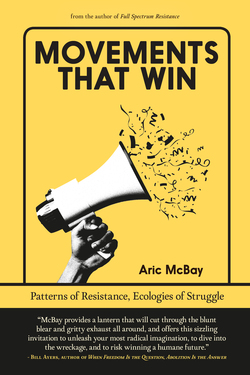
In the afterword to Movements that Win, excerpted below, author Aric McBay explores the different tactical patterns that he observed when compiling the stories he presents throughout the book. Aric McBay offers a variety of paths forward, all based on the achievements of actions and movements past. If we need anything at this moment of increasing fascism and authoritarianism — both globally and domestically — we need concrete examples of victories and clear analysis of what made those victories possible, so we, too, can be victorious. While reading this text, consider the ways in which your organizing work embodies these patterns, if it does, and, if it doesn't, the ways in which you may further implement the forward-thinking ideas presented in text.
Patterns of Resistance
Writing Movements that Win has been a source of joy and optimism for me. Although I’ve been involved in movements since I was a teenager, while researching this book, I found new stories that will nourish and inspire me for years to come.
As a reader, I hope you have also found new reasons for optimism in these pages. I hope your spirits have been lifted and you can see new avenues for action.
Some stories in this book were surprising to me. However, despite the variety and diversity of these examples, I have repeatedly found the same patterns behind movements that win.
Writing this book has strengthened some of my core beliefs about how social movements make change — in particular, the need for direct action, coalitions across differences, and the importance of building movement capacity at the grassroots level. I found twelve key patterns in these stories. For simplicity and coherence, I’ll place these twelve patterns into three groups: purpose, action, and organization:
PURPOSE:
1. A Tangible Common Goal
2. Positive Vision
3. Urgency (Imminence/Emergency)
4. A Common Enemy
ACTION:
1. Initiative and Escalation
2. Disruption and Direct Action
3. A Common Tactic and Collective Action
4. Diversity of Tactics and Radical Flanking
ORGANIZATION:
1. Coalitions Across Difference
2. Movement Capacity
3. Participatory Decision-Making and Democracy
4. Persistence and Endurance
Let’s begin with purpose. Our first four patterns all have to do with the goals and context of a movement. What do they want to achieve, and what environment are they operating in?
1. A TANGIBLE COMMON GOAL
In all these stories, community members and activists from different backgrounds had to rally together around a tangible common goal. They wanted to accomplish something specific and were able to do it together.
When Revolution of the Heart convened, its goal was clear: removing a specific colonial statue. That clarity and the ability to organize at a specific location were essential to its success.
Likewise, the struggle against the Richmond Dump was about a specific piece of land and community. There were particular people, wells, and wildlife being adversely affected by the dump. That made it easy to focus efforts on the problem’s source and organize and unify community efforts.
The same was true for the campaigns around Parcel C, the Green Bans, the Wyhl Reactor Site, and many others.
All these groups could have chosen more abstract or diffuse goals. The Revolution of the Heart could have chosen to focus on “colonialism” in general, but that kind of vague, amorphous system is much harder to rally around.
Likewise, the Richmond Dump organizers could have focused on opposing the concept of waste in general—but would 90 percent of their neighbors have signed a petition against “waste”? It’s very difficult to mobilize people to fight an abstraction.
I’m not saying we shouldn’t oppose harmful systems or name them as things we want to change—to the contrary. However, if we’re aiming to change big and abstract systems, we need to find intermediate goals and stepping stones that will let us achieve wins and build momentum.
2. POSITIVE VISION
While many of the stories in this book were oppositional, at least in part, successful movements were also guided by a positive vision of what they wanted to create or protect.
Parcel C organizers didn’t just want to stop a parking garage; they wanted a community center for Boston Chinatown.
The radical unionists of the Green Bans wanted to protect specific neighborhoods and places. But they also wanted to forge an intersectional working-class movement in which unions also fought racism, homophobia, and imperialism. They wanted to build a “socialist world with a human face, an ecological heart, and an egalitarian body.”
Many Indigenous-led movements discussed—like the Wet’suwet’en struggle or the Revolution of the Heart—were about more than Indigenous survival; they were about reshaping the larger society to become more just and self-aware.
Indeed, sometimes the method of opposition created the positive model needed—like how the camp opposed to the Wyhl nuclear reactor created its own “college” and eventually became a nature reserve.
A clear, positive vision allows us to be more strategic and use our limited resources as community activists. It guides us, gives us a direction to move toward, and motivates and sustains organizers and supporters. Few people want to participate in a social movement if the only options are different kinds of defeat or if struggle only prolongs the inevitable.
People need a positive, transformative vision of a future worth living in. Now, especially.
3. URGENCY
Just because a problem exists doesn’t mean people will act against it. Something needs to motivate people to get involved rather than wait for someone else to solve the problem. There must be some reason to set aside business as usual so that people go to the streets instead of staying home and watching Netflix.
Often, that reason is urgency. People respond much more actively to the threat of imminent harm than to something that may be a problem one day.
There’s a reason activists have reframed climate change as a climate “emergency.” Climate change is notoriously difficult to organize against because it can feel so nebulous and distant.
The environmental justice wins described in this book are tied to specific, tangible plans and specific, urgent threats. The Brent Spar was on the verge of being sunk. Doug Ford’s gas plants were within weeks or days of being approved. The Richmond Dump was an active and growing threat to groundwater.
4. A COMMON ENEMY
Rallying people from different backgrounds around a joint campaign isn’t easy. A tangible goal helps, and so does an emergency.
But one particular thing helps people put aside their differences: a common enemy.
In the struggles against the Northern Gateway and Line 9 pipelines, that common enemy was fossil fuel giant Enbridge. It’s often a corporation, whether Unocal at Umbergaon, Waste Management at the Richmond Dump, or Walmart . . . everywhere.
Other times, the common enemy is the government: the German government in the struggle at Wyhl or the UK government in the case of the movement for nuclear disarmament.
Governments, though, can be sprawling. It’s best to put pressure on specific figures and decision-makers whenever possible. Opponents of the Brent Spar painted Prime Minister John Major as a “redundant rig” to be dumped. Organizers of the 504 Disability Sit-ins focused much of their effort on Joseph Califano, the federal secretary of Health, Education, and Welfare.
That’s the last pattern in the purpose and context group. Next, let’s look at four more patterns: those of action.
5. INITIATIVE AND ESCALATION
In these stories (and in the wider world!), we see again and again that officials in corporations and government funnel dissent into bureaucratic or technical channels where community power can be controlled and dominated.
The United States government stalled the implementation of the disability rights measures in Section 504 of the Rehabilitation Act of 1973 by starting another review of regulations. Opponents of Line 9, the Richmond Dump, and the proposed nuclear waste dump spent years engaging in technical and bureaucratic reviews.
The City of Kingston tried to direct opposition to a colonial statue into a committee discussion about how the wording of a plaque might be adjusted.
Eventually, though, activists broke from those systems, seized the initiative, and went outside official challenges to do something bold and challenging. Activists kept their eyes on the prize, focusing on the specific tangible outcomes they wanted to achieve so they could avoid being derailed by a bureaucratic process that was meant to stifle them.
Sometimes this meant escalating the struggle, raising the stakes. Site occupations or sit-ins (like Revolution of the Heart, the Brent Spar, Wyhl reactor site, and the 504 disability sit-ins) were all meant to escalate the struggle and keep it from being ignored. They also created a sense of urgency that people could rally around to crystallize abstract issues into clear and tangible problems to be confronted.
Smart groups can also take the initiative by being proactive or preemptive. Al Norman’s ultimate advice to stop corporations like Walmart was to put in place zoning bylaws that would explicitly pan big-box stores, avoiding the need for a site fight altogether. The struggle against the Energy East pipeline was likewise successful because of its willingness to preempt the bureaucratic hearing of the National Energy Boards with disruption and direct action.
6. DISRUPTION AND DIRECT ACTION
Disruption and direct action are among the most powerful tools we have as movement workers. In so many campaigns, our worst enemy is business as usual. Business as usual means the constant march of gentrification, corporatization, and growing inequality (as with the Green Bans, Parcel C, and the struggle against Walmart).
Business as usual also means the gradual accumulation of a threat that could eventually become catastrophic, as with climate change or nuclear war.
Direct actions such as sit-ins, strikes, and blockades provide powerful tools to disrupt or stop business as usual.
Disrupting business as usual has many benefits. One is that it creates a strategic dilemma that those in power feel pressure to resolve. Recall how the Revolution of the Heart was able to get a quick response in part because city hall didn’t know how to manage them or control such a bold action.
Direct action like the rail blockades of Shut Down Canada can create a strong economic cost that corporations and governments can’t tolerate. The same was the case for the Brent Spar struggle, which combined both an occupation and boycotts to produce a high economic and political cost for those in power.
The bureaucratic management of dissent—through hearings or courts—is meant to put activists on a field of struggle that is rigged in favor of big corporations and colonial governments. It is meant to put us on a plane of conflict where we are at a disadvantage.
The benefits of direct action—and taking the initiative—are that we get to decide where conflict happens. We leverage the power of asymmetry. We choose a place where those in power are weak and we are strong. We get more control of the narrative.
7. A COMMON TACTIC AND COLLECTIVE ACTION
Movements that win use collective action of some kind. Individual actions alone—even good actions like buying fair trade coffee or flying less—cannot overturn entrenched systems of power. The boycotts against Shell, marches of the nuclear-disarmament movement, and the construction bans in Sydney were all examples of common tactics that brought together people from many backgrounds to pursue a common cause.
But that’s not the only way to do things. Indeed, collective action can be even more powerful when it involves many kinds of action at once.
8. DIVERSITY OF TACTICS AND RADICAL FLANKING
The most powerful movements use many tactics simultaneously—from petitions to legal challenges to direct action. This maximizes the impact by encouraging many different people to participate in the way that best suits them, using their particular gifts and skills at a risk level they feel comfortable with.
Sometimes, groups diversify their tactics because of the failure or shortcomings of a broader movement, as with the Committee of 100 and the Spies for Peace (and, to some extent, Energy East). Ideally, a strategy of diverse tactics is intentional, as with the 504 disability sit-ins.
Smart use of diverse tactics can also strengthen a movement through radical flanking, as we saw in the struggles against the Richmond Dump and the nuclear waste dump in South Australia.
Radical flanking at work during Revolution of the Heart’s effort to remove the statue of John A Macdonald. Kingston officials had ignored requests to take down the offensive statue for years. However, the escalation of direct action meant that a negotiated removal of the statue was suddenly the most appealing option, especially after the toppling and destruction of colonial statues in other cities.
9. COALITIONS ACROSS DIFFERENCE
To generate the political strength needed to create substantive change, movements that win create powerful coalitions across differences.
The Green Bans were not only a struggle to preserve green space but also for working-class neighborhoods and the rights of women, Indigenous People, and queer people.
Opponents of Doug Ford’s gas plants were able to rally students and seniors, Indigenous people and farmers, climate justice advocates and public health experts. The struggle to salvage Parcel C for Chinatown likewise rallied not only the community but lawyers, healthcare advocates, and Quakers.
This ability to organize across differences is critical. Bridge-builders who convene supporters from diverse communities can, of course, increase the number of people and resources involved. However, they also bring together new perspectives that boost a movement’s strategic capacity.
The organizers of the 504 disability sit-ins would not have succeeded without the solidarity they cultivated to bring together disability rights activists along with Black Panthers, unionists, queer organizers, and the United Farm Workers.
Such alliances can open new possibilities for transformative action and dramatically increase a campaign’s overall capacity. Indeed, along with a diversity of tactics, cooperation between allied groups is essential to building healthy and strong ecologies of struggle.
10. MOVEMENT CAPACITY
Effective organizers must consider the specific capacities needed to reach their goals. Capacities like recruitment, communications, security, and logistics.
My book Full Spectrum Resistance was structured with a chapter for each of these important capacities, asking: “How do you recruit the people you need and keep them? How do you organize into groups that can cooperate and get things done? How do you moderate internal conflict? How do you reach out to new allies and supporters? How do you protect yourselves and your comrades from repression? How do you gather the intelligence you need to choose good targets? How do you work out the strategy and tactics you need to mobilize force in a rapidly changing political conflict? And how have movements of the past done these things?”
All movements need strategy and tactics. Movements must reach large numbers of people—like campaigns for Nuclear Disarmament—and more strongly develop their communications capacity. Groups that take on bigger risks—like the Spies for Peace or the Green Ban organizers—must build their skills in security and counterintelligence. And organizations that want to organize difficult or prolonged occupations—like those of the Brent Spar or the Wyhl Reactor Site—must master logistics if they want to win.
It’s also important to look at building not just single campaigns, but enduring and intersectional movements. When we build successful movements, we can make transformative changes on a much larger and more lasting scale than any one campaign.
11. PARTICIPATORY DECISION-MAKING AND DEMOCRACY
Each victory described in this book involved democratic decision-making in how activists organized themselves and wanted society to function.
When I spoke to Hereditary Chief Na’Moks of the Wet’suwet’en, I asked him what he ultimately wanted to attain. “Democracy,” he told me.
Remember the story of the Green Bans? When the suburban women in Hunter’s Hill wanted help from the builder’s union, the union agreed to help on the condition that the residents vote in favor of a green ban.
The campaign around Parcel C converged on a people’s referendum and was meant to capture the collective wishes of Boston Chinatown.
The petition gathered by opponents to the Richmond Dump—boasting signatures from 90 percent of residents—showed the democratic will of the community.
Operating in a democratic and participatory way is a means of building strong movements and strategic capacity.
In contrast, some movements mentioned suffered greatly from a lack of democracy. The early anti-nuclear movement in the UK was stymied in part by the paternalistic approach of Canon Collins. The potential of the Green Bans was ultimately thwarted by the hierarchy of Gallagher and the national union.
12. PERSISTENCE AND ENDURANCE
Movements that win are movements that last. In his book The Strategy of Social Protest, William Gamson argues that social movements that can last until a broad societal crisis are likely to achieve their goals. Movements need persistence for many reasons. One is that building relationships—building movements—takes a lot of time. This book includes several examples of movements that won quickly. Revolution of the Heart reached its goal after only ten days of action, while some of our municipal campaigns against Ford’s gas plants lasted less than a week.
But those efforts succeeded because they were the manifestation of many years of groundwork and relied on relationships and networks that had already been cultivated.
Building movements and making change isn’t easy. There are times, though, when it’s easier. A movement that can endure will eventually find opportunities that it can be ready to seize.
If the movement organizers are strategic, they’ll have used that time to strengthen relationships, gather resources, and develop shared skills.
In other cases, movements don’t need to wait for an opportunity so much as they need to outlast their opponent.
Many of the places protected by the Green Bans still exist today, in part because organizers were able to endure until the economic circumstances driving development had changed.
Even the win against Energy East resulted from delaying the process until that pipeline was no longer economically feasible.
I want to make an important caveat: Persistence is essential, but it doesn’t win campaigns. If doing the same thing for six months doesn’t lead to progress, doing the same thing over and over for six years is unlikely to be an improvement.
Endurance is valuable because of what we do with our time: grow our numbers, make alliances, learn new skills, try new tactics.
If we want to last in the long haul, however, we also need to think about how to retain people. What makes movement workers want to stick around? What makes them feel invested and have a stake in decision-making? How do we build a track record of wins that encourages people?
This quality, persistence, is in some way the result of all the other qualities combined. The ability to endure isn’t just a matter of willpower—it’s also a result of making many good strategic decisions along the way.
THE END OF THE BEGINNING
A nice, tidy novel can end in a nice, tidy way—resolve the major conflict, wrap up loose threads, and send the satisfied reader on their way. This is not that kind of book. We do not live in a novel. The real world is messy, and there is much work to be done. There are many reasons movement workers are unsatisfied.
So, let me conclude this book with a challenge: Let this not be the end. Help the stories, patterns, and victories in this book live beyond these pages.
If you haven’t already, gather your friends and comrades to discuss and learn from the victories that inspire you. Don’t just learn from the history of whatever movements you work in—learn from other struggles to cross-pollinate and invigorate your work.
Together, we can forge more intersectional and effective movements, building a better, more just, and more liveable future for all.
ARIC MCBAY is an organizer, a farmer, and author of five books. He writes and speaks about effective social movements, and has organized campaigns around prison justice, Indigenous solidarity, pipelines, unionization, and other causes. You can find his work at www.aricmcbay.org.

Aric McBay is an organizer, a farmer, and author of four books. He writes and speaks about effective social movements, and has organized campaigns around prison justice, Indigenous solidarity, pipelines, unionization, and other causes. You can find his work at www.aricmcbay.org.