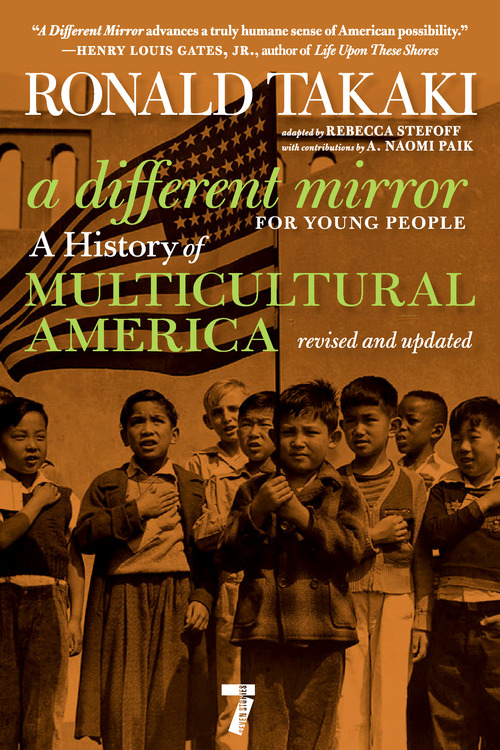
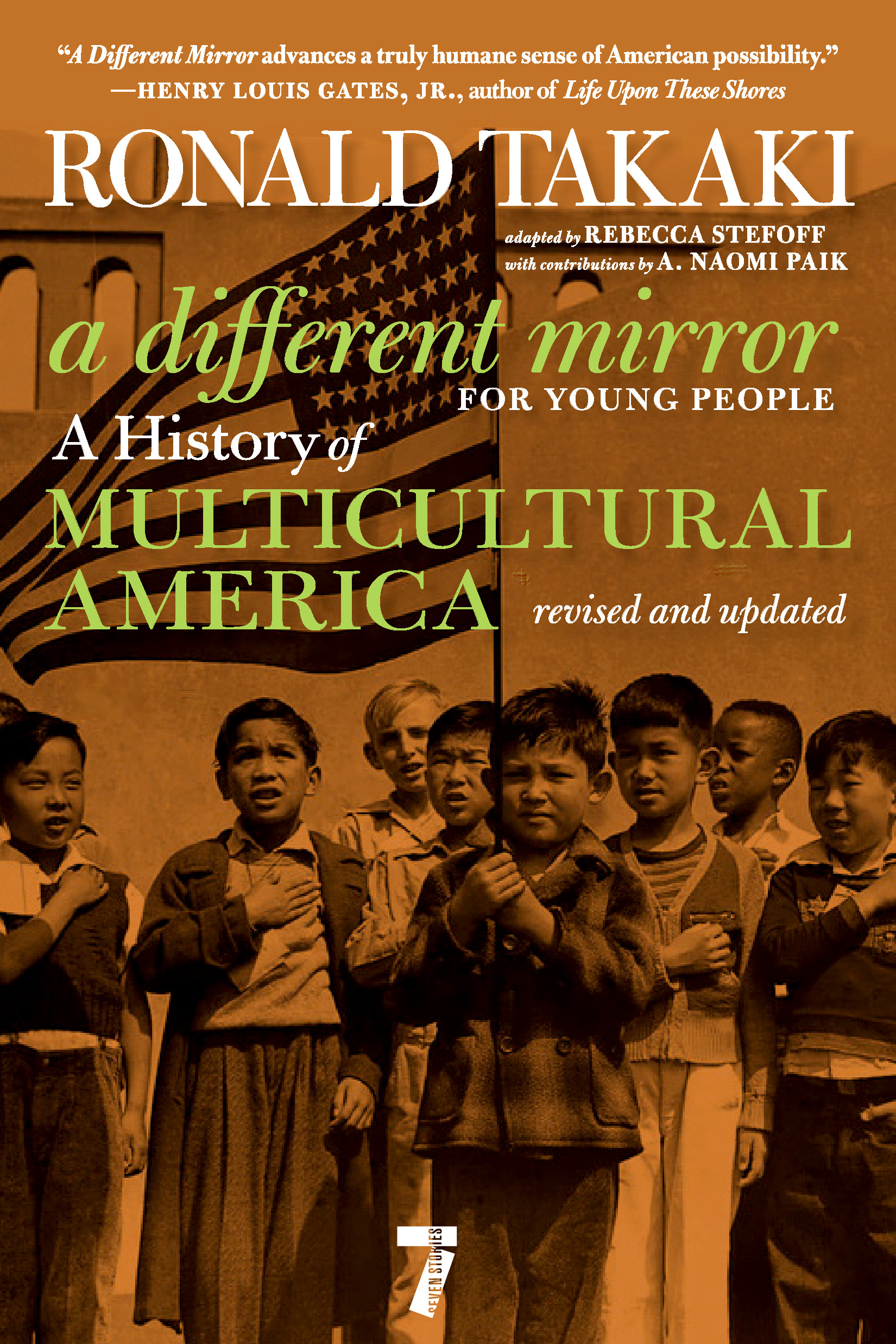
The groundbreaking multicultural history of America, adapted for younger readers, now in a revised and updated edition with 100+ pages of new material.
“An excellent way to include multi-ethnic materials in the classroom as a way to ensure that your students see their unique identities reflected in their coursework.”
—Skipping Stones
In Ronald Takaki's multicultural masterwork, the story of America includes the Native, African, Irish, Jewish, Asian, and Latine people—and many more—who made America their home, and who often fought for rights now enjoyed by all. A Different Mirror for Young People is widely hailed as the most important resource to “teach [Americans] to value the nation's inescapable diversity" (New York Times Book Review) and has been adopted into middle and high school curricula around the country.
With a new chapter and revisions throughout, University of Illinois professor A. Naomi Paik brings this “brilliant revisionist history” (Publishers Weekly) into the 21st century. The new material examines growing inequality in the U.S., the intensifying War on Terror that further targets and marginalizes immigrants, and, in the uplifting spirit of the original book, the emergence of social movements including land and water protections and migrant justice movements.
Drawing on Takaki's vast array of primary sources, and staying true to his own words whenever possible, A Different Mirror for Young People brings ethnic history alive through the words of people, including teenagers, who recorded their experiences in letters, diaries, and poems. Like Howard Zinn's A People's History, another title in the For Young People series, Takaki's A Different Mirror offers a rich and rewarding "people's view" perspective on the American story.
"The 'mirror' that Ronald Takaki holds up to the United States reflects a multicultural history of oppression and exploitation, but also struggle, solidarity, and community. In the most profound sense, this is a people's history of our country. Takaki shows what has torn us apart, yet what knits us together."
—Bill Bigelow, curriculum editor, Rethinking Schools, and co-director, Zinn Education Project
GETTING FREE OF THE MASTER NARRATIVE
BY A. NAOMI PAIK
Along with my elementary-school classmates growing up in Lubbock, Texas, I learned about the 1836 Battle of the Alamo. At a fort in Texas, which was then part of Mexico, American settlers sought freedom from Mexican oppression. They fought to the death inside the fort, leaving no man standing. (As children, we did not ask how the story was known, if no one had lived to tell it.) We watched the John Wayne film that showed the white cowboys as heroes and the Mexican characters as evil. Now, years later, I think that the adults in the school never considered how this narrative might strike the many Mexican American students and teachers.
Some of them, I can guess, felt the way I did as an Asian American high-school student when my US-history teacher told our class that Japanese Americans were jailed in prison camps during World War II for their own safety, with their support. I entered high school with more than seven hundred students in my grade, but fewer than three hundred and fifty of us remained when I graduated. Did that fact have something to do with what we were taught? Our education was rooted in what Ronald Takaki called the “Master Narrative.”
It was not until college that I learned a fuller history of the Alamo. Mexico invited white American settlers into Texas to help take over the territory from Indigenous nations who had long lived in these lands. But when the Mexican state abolished slavery, those white settlers revolted, refusing to give up their human “property.” The Battle of the Alamo and the war for Texan independence was a revolt to preserve slavery.
It has been decades since I attended school in Texas. It seems the education offered there continues to selectively edit history by the unspoken rules of the Master Narrative. As a college professor, I now use excerpts from Texas history textbooks to teach about how language, including the passive voice, can be used to reinforce those rules. Take this short passage: “Some slaves reported that their masters treated them kindly. To protect their investment, some slaveholders provided adequate food and clothing for their slaves. However, severe treatment was very common. Whippings, brandings, and, even worse, torture were all part of American slavery.”
What do you notice about this passage? “Masters” and “slaveholders” are identified as acting humanely, with kindness and charity, but they disappear when the passage shifts to the passive voice to describe the violence of slavery. Who treated severely? Who whipped, beat, and tortured? And who was on the receiving end of this brutality? The same textbook called enslaved people taken from the shores of Africa “workers” who “immigrated” to the United States.
I believe that you, the young person reading this book, deserve better. I trust that you can handle the truth. You’re smarter and stronger than we might think! I know that you can face and learn from the hard parts of our history and use that knowledge to create a better present and future. My belief in you is what motivated me to become a scholar and teacher in the first place. My students continue to drive me to study, discover, and tell the truth, even in those times when the truth is rewarded with punishment. My students, and you, make me brave.
The work of Ronald Takaki, the author of this book, helped make my own work possible. Takaki was part of a generation of scholars who helped build ethnic studies, a field of inquiry born out of social movements that confronted structural racism, the laws and practices built into government and other institutions that keep racial and ethnic inequality alive. Ethnic studies arose as people worked to create a more just and equitable world for everyone. On campuses like the University of California, Berkeley and San Francisco State, students, faculty, campus workers, and community members came together to demand education that they could use to serve their communities. Together, they went on strike, shut down campuses, and created their own shared spaces of learning.
These organizers and activists understood that education and knowledge are tools of power. Like enslaved people who taught themselves to read in secret, and Indigenous people who held to their languages and traditions even when the government used force to erase them, these activists demanded an education that would empower them to make positive change against oppressive systems.
Their opponents who ran those systems understood the power of education and knowledge, too. Blocking education is a way of blocking power. In response to campus protests in the 1960s, politicians took funds away from public higher education to prevent the growth of an educated working class. Making students take on huge amounts of debt not only puts education out of reach for many but also inspires resentment against educated people. But it is an educated population that creates the foundation for a robust democracy.
This book comes out of this legacy of knowledge, power, resistance against oppression, and building a better world together. It is an effort toward achieving a US democracy like the one expressed in documents like the Declaration of Independence, which states “that all men are created equal, that they are endowed by their Creator with certain unalienable Rights, that among these are Life, Liberty and the pursuit of Happiness.” This vision of US democracy is still in a state of becoming. It is yet to be realized.
As the early decades of the twenty-first century show, our democracy is fragile. All of us must fight for and defend it. Part of that democratic work is understanding US history in all its complexity— the successes and failures, the parts that make us proud and the parts that make us want to do better. Defending democracy requires getting real about why and how we have strayed from core US principles and learning how, as our nation moves forward, we can respond differently to similar challenges.
The history offered in this book offers many examples of people working together to change the country! One of them was James G. Thompson, a Black soldier who returned from fighting in World War II to fight for equality at home. He and others never stopped believing in US principles, even when they had every reason to do so. As Thompson powerfully stated: “Though these questions often permeate my mind, I love America and am willing to die for the America I know will someday become a reality.” I hope this history inspires and moves you to bring the United States closer to its ideals, to help make it a place defined by equality, liberty, and justice for all.
A. NAOMI PAIK is an associate professor of Criminology, Law, & Justice and Global Asian Studies at the University of Illinois, Chicago. She published Rightlessness: Testimony and Redress in U.S. Prison Camps since World War II (UNC Press, 2016; winner, Best Book in History, AAAS 2018; runner-up, John Hope Franklin prize for best book in American Studies, ASA, 2017). Her book Bans, Walls, Raids, Sanctuary: Understanding U.S. Immigration for the 21st Century (2020, University of California Press), examines the long-developing criminalization of foreign-born people in the United. Her research and teaching interests include comparative ethnic studies; U.S. imperialism; U.S. militarism; social and cultural approaches to legal studies; transnational and women of color feminisms; carceral spaces; and labor, race, and migration. https://naomipaik.com/
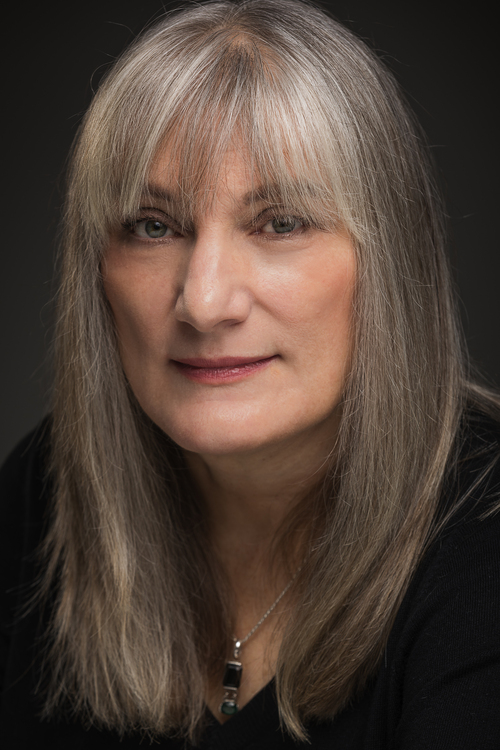
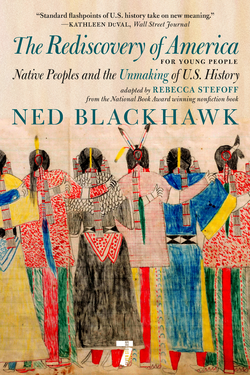
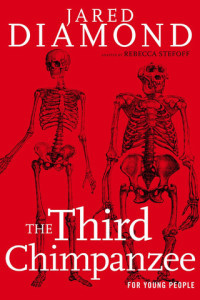
Rebecca Stefoff has devoted her career to writing nonfiction books for young readers. Her publications include histories, literary biographies, an encyclopedia of maps, and numerous books on science and environmental issues. She has also adapted a number of landmark works in history and science, include Howard Zinn's A People's History of the United States, Jared Diamond's The Third Chimpanzee, Charles C. Mann's bestselling 1493, Jill Jonnes's Eiffel's Tower, and Ronald Takaki's A Different Mirror for Young People: A History of Multicultural America.

Ronald Takaki (1939–2009) is recognized as one of the foremost scholars of American ethnic history. Born and raised in Oahu, Hawaii, the descendent of Japanese immigrant field workers, Takaki became the first member of his family to receive higher education, attending The College of Wooster in Wooster, Ohio, and later receiving a doctorate in history from the University of California, Berkeley. Takaki has said that he was “born intellectually and politically” during this period in Berkeley in the 1960s. His PhD dissertation was on the subject of slavery in America, and he went on to teach the first black history course at the University of California, Los Angeles, in the aftermath of the Watts riots. Returning to Berkeley, Takaki helped found the nation’s first ethnic studies department and rose to national prominence publishing works on the history of immigration and the understanding of ethnicity in the Americas. His 1989 title Strangers from a Different Shore: A History of Asian Americans was nominated for a Pulitzer Prize. Takaki died in 2009.
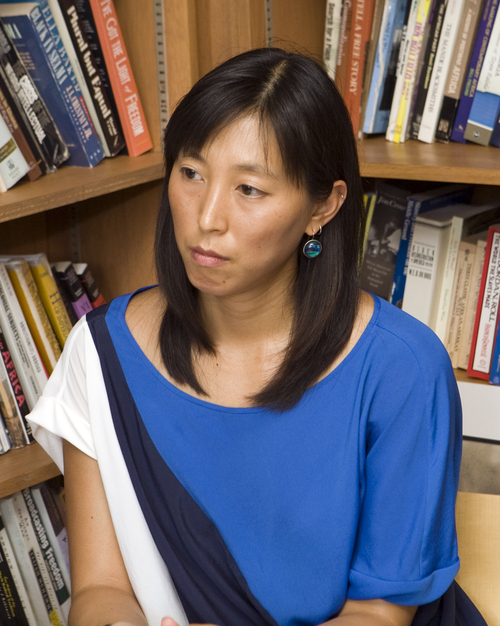
A. NAOMI PAIK is an associate professor of Criminology, Law, & Justice and Global Asian Studies at the University of Illinois, Chicago. She published Rightlessness: Testimony and Redress in U.S. Prison Camps since World War II (UNC Press, 2016; winner, Best Book in History, AAAS 2018; runner-up, John Hope Franklin prize for best book in American Studies, ASA, 2017). Her book Bans, Walls, Raids, Sanctuary: Understanding U.S. Immigration for the 21st Century (2020, University of California Press), examines the long-developing criminalization of foreign-born people in the United. Her research and teaching interests include comparative ethnic studies; U.S. imperialism; U.S. militarism; social and cultural approaches to legal studies; transnational and women of color feminisms; carceral spaces; and labor, race, and migration. https://naomipaik.com/