August 04


Translated by Christina MacSweeney
In this debut novel, Clyo Mendoza, a young, award-winning Mexican poet and novelist, weaves together multiple narratives into a lyrical, shape-shifting existential reflection on love, violence, and the power of myth.
“Fury has the poetic and wild force of the desert. In its pages there is tenderness, fear and forceful, rhythmic writing with images that are difficult to forget. It is about the violence of desire that turns us into dogs that drool, howl and bite, but also about love in the midst of hostility and helplessness. This is why it is a disturbing and, at the same time, deeply moving novel.” —Mónica Ojeda
In a desert dotted with war-torn towns, Lázaro and Juan are two soldiers from opposing camps who abandon the war and, while fleeing, become lovers and discover a dark truth. Vicente Barrera, a salesman who swept into the lives of women who both hated and revered him, spends his last days tied up like a mad dog. A morgue worker, Salvador, gets lost in the desert and mistakes the cactus for the person he loves. Over the echoes of the stories of these broken men—and of their mothers, lovers and companions—Mendoza explores her characters’ passions in a way that simmers on the page, and then explodes with pain, fear and desire in a landscape that imprisons them.
After winning the International Sor Juana Inés de la Cruz Poetry Prize, Clyo Mendoza has written a novel of extraordinary beauty where language embarks on a hallucinatory trip through eroticism, the transitions of conscience, and the possibility of multiple beings inhabiting a single body. In this journey through madness incest, sexual abuse, infidelity, and silence, Fury offers a moving questioning of the complexity of love and suffering. The desert is where these characters' destinies become intertwined, where their wounds are inherited and bled dry. Readers will be blown away by the sensitivity of the writing, and will shudder at the way violence conveyed with a poetic forcefulness and a fierce mastery of the Mexican oral tradition.
Collected in
Women in TranslationChristina MacSweeney on translating “Silencio” by Clyo Mendoza
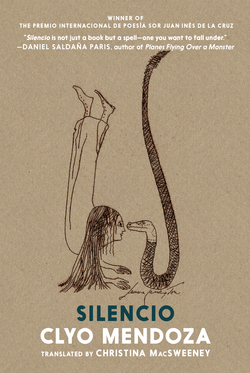
On the publication date of Silencio by Clyo Mendoza, a poetic, lyrically haunting novel of women surviving femicide and destruction in Mexico, we’re proud to share a letter to the reader by translator Christina MacSweeney. In the letter, which you can read in full below, MacSweeney explores, among other things, the complexity and challenges of translating a prose-poetry novel written in multiple languages: Mexican Spanish, as well as the Indigenous languages Zapotec, Isthmus Zapotec, and Tacuate.
Where to being in addressing the levels of complexity that have been involved in translating the prose-poem-reportage of Clyo Mendoza’s Silencio?
As translation involves a movement between languages, that would seem a good place to start. The original text of Silencio includes Mexican Spanish and three Indigenous languages: Zapotec, Isthmus Zapotec, and Tacuate. These last three are in danger of extinction in Mexico yet, as Yásnaya Elena A. Gil points out in her essay “Blood, Language and Surname: Indigenous Women and Nation States,” they are also used by the State as criteria for officially belonging to an Indigenous group. Such policies exclude people who for one reason or another have not had the chance to learn their mother tongue and they have, paradoxically “led to an ever-faster loss of Indigenous languages.”* In a personal communication, Clyo Mendoza told me that her aim in including these languages was not that of “saving” them—a possibly grandiloquent gesture—but had to do with the pleasure it would give their speakers, both in Mexico and the diaspora in the United States, to see them written down. However, the movement between languages is never a simple process of substitution and in Silencio, the narrator frequently mentions “the language of steel and grass” that “imitated the flowing of water, the voices of trees,” and has now been outlawed by the Church. How could a language of pure sound be transformed into one of pure words and then again to another language of words in a very different setting? And then there is the language spoken by the “child drunkards” that nobody understands, but people who hear it feel they are “witnessing the birth of a new language, of language itself.” While translating the sections of Silencio written in Indigenous languages, I read them aloud to get a feel for, if not their sound, at least the rhythm of the words. It might perhaps have been simpler to eliminate these Indigenous languages and retain the Spanish with an English translation, but that would have both added to that “ever-faster loss” of the languages and denied speakers of them the pleasure of seeing those words written down in a different context.
Having considered language, it seems logical to move on to the issue of voices in the translation of the novel. In terms of the human characters, Águeda’s voice moves between lyricism and a prosaic description of her plight; her mother’s is surreal, seems to follow the flow of the water that carries her to the sea; the voices of the immigrants—Laura, Edna, and María—are more journalistic, a simple recounting of their stories. But in addition to the humans, other members of the animal kingdom are given voice in the text: a she-dog, a dog, a horse, and a bird; even stones speak. Each has their own world view, their own particular way of expressing it through language. The Horse, for example, sees itself as an organic part of the greater whole that is the world, and so cannot understand the human notion of love for an individual. Its voice is confident, composed, aware of the limitations of language. And although the trees and the water do not actually speak, their sounds provide the background music of the work. Listening to this polyphonic symphony of human and nonhuman music requires a carefully tuned ear; reproducing it in another language has been a challenge I hope I have risen to.
Another issue that arose almost immediately in my translation was related to the genre of the text. Although much of what we read is based on factual situations, Silencio delivers this in a wonderful mélange of prose poetry, literary prose, and reportage; the surreal imagery of the mother’s contributions is in sharp contrast to the excerpts from a military manual. It could be said that the genre of a book is unrelated to its translation; an issue for the marketing team, critics, and booksellers. Nevertheless, I must be aware of the often nuanced changes in register in Clyo Mendoza’s work and adapt my writing to them.
In my readings of Silencio in Spanish, I was drawn into Clyo Mendoza’s imagery, its sensuality, its musicality and rhythms. Water is a constant presence and the sea almost becomes a character in the mother’s journey to decomposition. The narrator tells us that when Águeda is released from captivity, she goes to bathe in the spring and, “unknown to her, the water carried her perspiration to the open sea covering her mother’s body.” There is a movement between solid and liquid states throughout the text, such as when the mother says, “I’m the muscle of the sea.” Once again, listening to the musicality of a text feeds into the reproduction of its imagery.
It would be impossible to write this note without mentioning the horrific violence described in Silencio. However, the violence meted out on women, including rape and femicide, is always present but never sensationalized in Clyo Mendoza’s writing, which, I feel, makes its impact stronger. The portrayal of violent characters like the father is nuanced; he initially appears to be the stereotypical Mexican, misogynist male narco, exploiting the inhabitants of the small town to harvest his crop, fathering illegitimate children, murdering his wife, locking up his daughter, the list goes on . . . But then we learn that he himself has been exploited and brutalized by people farther up the drug-trafficking hierarchy; he too is a victim.
One final point to address is the formatting of the English text. It is not uncommon in Spanish for dialogue to be represented in italics, and certain other elements of Silencio are also italicized in the original; my feeling was that this degree of italicization could be confusing for English readers. Working with my excellent editor, Elisa Taber, we devised a scheme in which spoken speech (in contrast to internal dialogue) was largely placed inside speech marks and separated by line breaks. Other than that, we respected the formatting of the Spanish text.
So, readers, treat Silencio as you would poetry; read and reread it. If you can speak one of the Indigenous languages, read the text aloud for yourself and for others. Teach others how to speak these languages. Help to keep them alive.
CHRISTINA MACSWEENEY has an MA in Literary Translation from the University of East Anglia. Her work has been recognized in a number of important awards. Her translation of Valeria Luiselli’s The Story of My Teeth was awarded the 2016 Valle Inclán Translation Prize and also shortlisted for the Dublin Literary Award (2017). Her most recent translations include fiction and nonfiction works by Daniel Saldaña París, Elvira Navarro, Verónica Gerber Bicecci, Julián Herbert, Karla Suárez, and Jazmina Barrera, whose autobiographical text, Linea Nigra, was a double finalist in the NBCC awards (translation and autobiography). She has also contributed to anthologies of Latin American literature and published translations, articles, and interviews on a variety of platforms. Her translations of Clyo Mendoza's novels Fury (2024) and Silencio (2026) are published by Seven Stories Press.
CLYO MENDOZA (Oaxaca, México, 1993) is a poet and novelist. She is the author of the poetry collection Anamnesis (2016), and the novels Silencio (2026), which was awarded the Premio Internacional de Poesía Sor Juan Inés de la Cruz, and Fury (2024), which was awarded the Premio Javier Morote by the Confederación Española de Gremios y Asociaciones de Libreros and the Amazon Premio Primera Novela. She has contributed to numerous poetry anthologies, including Poetas parricidas (Cuadrivio, 2014), Los reyes Subterráneos: Veinte poetas jóvenes de México (La Bella Varsovia, 2015), and Liberoamericanas: 80 poetas contemporáneas (Liberoamérica, 2018). Mendoza is the recipient of scholarships from the Mexican Fondo Nacional para la Cultura y las Artes and the Fundación Antonio Gala, in Córdoba, Spain. She has also collaborated on various transdisciplinary projects and experiments with painting, photography, and sound collage.

CLYO MENDOZA (Oaxaca, México, 1993) is a poet and novelist. She is the author of the poetry collections Anamnesis (2016) and Silencio (2018), which was awarded the Premio Internacional de Poesía Sor Juan Inés de la Cruz, and the novel Furia (2021), which was awarded the Premio Javier Morote by the Confederación Española de Gremios y Asociaciones de Libreros and the Amazon Premio Primera Novela. She has contributed to numerous poetry anthologies, including Poetas parricidas (Cuadrivio, 2014), Los reyes Subterráneos: Veinte poetas jóvenes de México (La Bella Varsovia, 2015), and Liberoamericanas: 80 poetas contemporáneas (Liberoamérica, 2018). Mendoza is the recipient of scholarships from the Mexican Fondo Nacional para la Cultura y las Artes and the Fundación Antonio Gala, in Córdoba, Spain. She has also collaborated on various transdisciplinary projects and experiments with painting, photography, and sound collage.

Christina MacSweeney has an MA in Literary Translation from the University of East Anglia. Her work has been recognized in a number of important awards. Her translation of Valeria Luiselli’s The Story of My Teeth was awarded the 2016 Valle Inclán Translation Prize and also shortlisted for the Dublin Literary Award (2017). Her most recent translations include fiction and nonfiction works by Daniel Saldaña París, Elvira Navarro, Verónica Gerber Bicecci, Julián Herbert, Karla Suárez, and Jazmina Barrera, whose autobiographical text, Linea Nigra, is, at the time of writing, a double finalist in the NBCC awards (translation and autobiography). She has also contributed to anthologies of Latin American literature and published translations, articles, and interviews on a variety of platforms.