


Celebrate Black History: 30% Off Highlights from Our Catalog - 11 days
❤︎♡ 30% off Books for Your Valentine ♡❤︎ - 3 days
Skip Navigation

Seven Stories Press

Works of Radical Imagination

Works of Radical Imagination

New and Forthcoming Books from Seven Stories Press

New releases and bestselling titles from Seven Stories Press.

Free shipping with orders $25+

blog — February 17

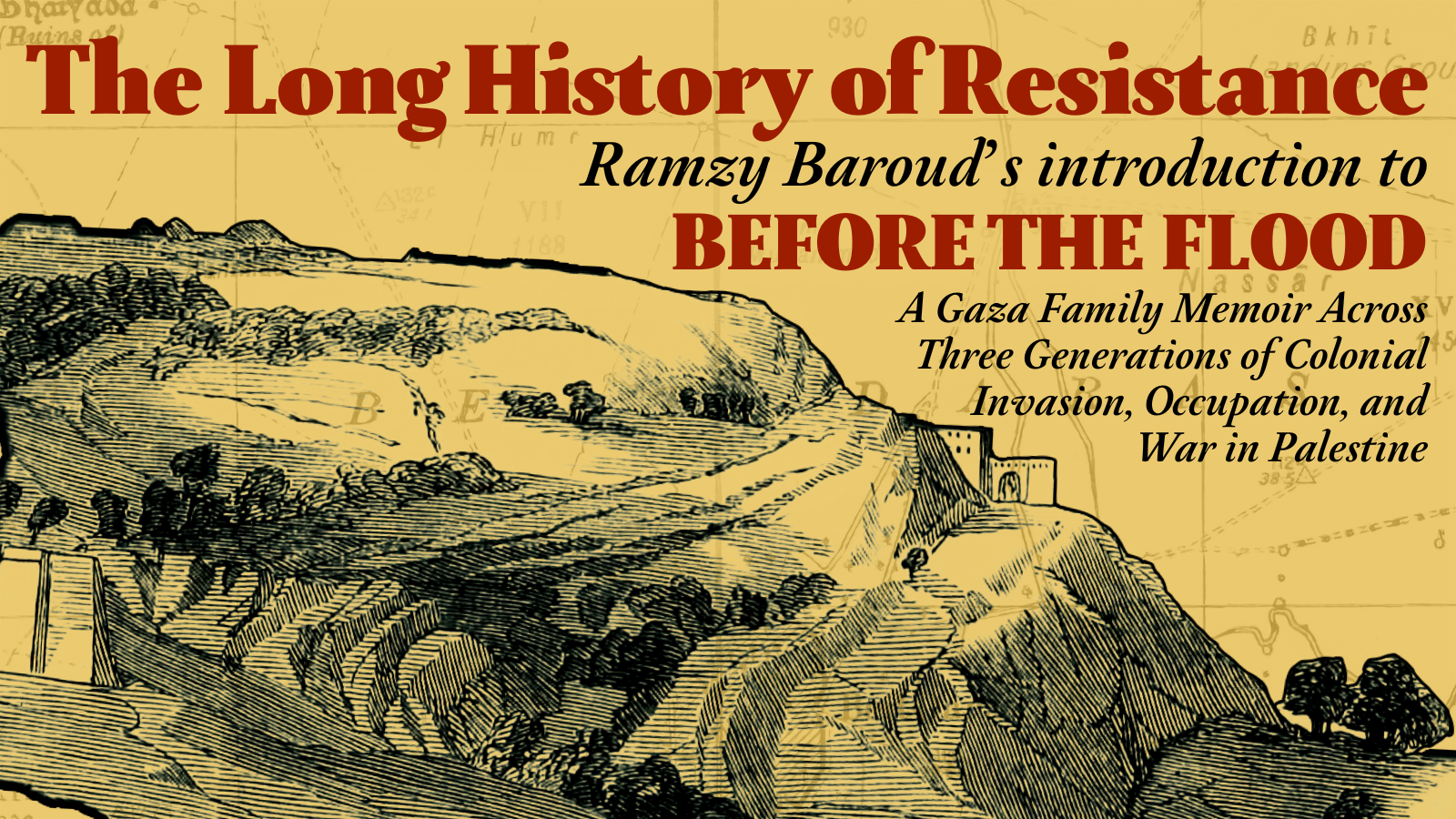
The Long History of Resistance: Ramzy Baroud’s Introduction to “Before the Flood: A Gaza Family Memoir Across Three Generations of Colonial Invasion, Occupation, and War in Palestine”

A profound exploration of Palestinian history and resilience through the personal stories of the author’s family—the al-Badrasawis. Beginning with intimate details of village life in Beit Daras prior to the Nakba, Ramzy Baroud vividly portrays the rich cultural heritage, deeply rooted traditions, and daily struggles faced by ordinary people whose lives were radically disrupted by the violent upheavals and ongoing conflicts driven by British colonialism and Zionist aggression.

Baroud weaves together past and present, illuminating how historical forces shaped the collective consciousness and steadfast resilience of the Palestinian people. His storytelling reveals not only the harsh realities of occupation, displacement, and loss but also the extraordinary courage, faith, and solidarity that underpin a powerful and enduring spirit of resistance, encapsulated in what the author refers to as the Palestinian “longue durée.” Ultimately, Baroud aims to humanize and reclaim Palestinian narratives from distorted portrayals, highlighting their perseverance and the universal quest for justice and liberation.


The Long History of Resistance

“One cannot give oneself courage if one does not have it.” This line comes from Alessandro Manzoni’s novel, The Betrothed. [1] It was uttered by Don Abbondio, a priest in the historical novel who courageously accepts his own cowardice.

Indeed, courage is not given. Like sacrifice, faith, camaraderie, community, resilience, even love itself, courage is an organic process that is innately formulated, often by circumstances beyond our reach. Collectively, such complex social structures could take many generations in the making, a process of which we are hardly cognizant.

Some traditional historians—who continue to subscribe to the methods of histoire événementielle, or event history—tend to ignore the remarkable effect of historical phenomena that often, over the course of many years or even centuries, impact our collective behavior. In his foreword to this book, Ilan Pappé references longue durée, the long-term consequences of history, a concept crafted by the founders and disciples of the French Annales School. [2]

Credible history can only be seen in its totality, not merely as the total events of history, recent or old, but as the sum of feelings; the culmination of ideas; the evolution of collective consciousness, identities, and relationships; and the subtle changes occurring in societies over the course of time. Palestinians are the perfect example of history being shaped by ideas, not guns; memories, not politics, collective hope, or international relations. The Palestinian people will eventually win their freedom because they have invested in a long-term trajectory of ideas, memories, and communal aspirations, which often translate to spirituality, a deep, immovable faith that grows stronger, even during times of genocide.

In my 2020 interview with the former United Nations Special Rapporteur, Professor Richard Falk, he summarized the struggle in Palestine as a war between those with arms against those with legitimacy. He said that in the context of national liberation movements, there are two kinds of war: the actual war, as in soldiers carrying guns, and the war for legitimacy. The one who wins the latter will ultimately prevail. [3]

Was it the knowledge of such an irreversible historical truth that led the Israeli historian Benny Morris to express his growing sense of pessimism about his country’s future? “The Palestinians look at everything from a broad, long-term perspective,” he said in an interview with the newspaper Haaretz in 2019. “They see that at the moment, there are five-six-seven million Jews here, surrounded by hundreds of millions of Arabs. They have no reason to give in, because the Jewish state can’t last. They are bound to win. In another thirty to fifty years, they will overcome us, come what may.” [4]

Morris is right: Palestinians will not give up. There can never be a situation where societies indefinitely survive and thrive based on a permanent system of racial apartheid, violence, and exclusion. The very history of Palestine — which I highlight in this book using people’s history and personalized narratives — is a testament to such a truth. If the oppressed, the Indigenous of the land, are not fully vanquished, they will rise, resist, fight, and win back their freedom, thus eventually winning the legitimacy war. Morris is right again when he indicates that Palestinian people collectively “look at everything from a broad, long-term perspective.” Agreeing with his argument may seem odd: societies are often fragmented by class struggles and competing socioeconomic agendas instead of unified by solidarity and a cohesive long-term collective vision. This is where longue durée becomes relevant in the Palestinian case. Even if Palestinians have not made a common agreement to wait for the invaders to leave, or for Palestine to once again become a place of social, racial, and religious coexistence, they are driven, even if subconsciously, by the same energy that compelled their ancestors to push back against the invaders. Characters in this book fulfill the historical role that was assigned to them by circumstances beyond their control. They are reanimating the past, just as their descendants will shape the future.

While many Western politicians today characterize Palestinian people as “terrorists,” blaming victims for resisting their own oppression, Palestinian society continues to evolve based on entirely independent dynamics. For example, the culture of Muqawama — Resistance — is deeply ingrained in Palestine. It is a culture as old as time. Innate. Intuitive. Intergenerational. It precedes the birth of Israel by thousands of years. Batis put it to the test when he led Gaza in legendary battles against the Macedonian invasion fomented by Alexander the Great in 332 BC. Batis may seem to be a footnote in this book, but, in fact, if read carefully, you will discover that he is the central character. He is the Zaher al-Umar al-Zaydani, the Izz al-Din al-Qassam, the Ghassan Kanafani, and Ehab al-Badrasawi, around whom this story is centered. The deep-rooted historical continuum between the Palestinian past, present, and future is the very essence of this book.

Before the Flood speaks of many things and many people, but ultimately it is about a branch of my family that has chosen to write — with their blood — a chapter in the unending Palestinian saga, demonstrating that history is not moved just by short-term events, but by countless factors. While in-the-moment events are important, longue durée provides a more profound understanding of our collective trajectory. Longue durée is concerned with historical shifts and changes that are situated within the realm of notions, ideas, collective perceptions, identities, and feelings, like courage and self-sacrifice for the sake of the group. These are the kinds of feelings that “one cannot give oneself . . . if one does not have.”

The anti-fascist intellectual Antonio Gramsci spoke about the importance of culture as a driver of history and meaning. “Culture isn’t having a well-stocked warehouse of news but is the ability that our mind has to understand life, the place we hold there, our relationship with other people. Those who are aware of themselves and of everything, who feel the relationship with all other beings.” [5] For a writer, these relationships fall under the concept of positionality, as in the relationship between the intellectual and their position, and how their position relates to the subject matter. This useful tool has given historians, especially those from the Global South, the power to navigate the painful terrain of our own victimization and long histories of oppression.

In this and all of my previous books, I have attempted to slowly liberate the Palestinian narrative from the convenient histories imposed on my people. It is not an easy task, but an unavoidable one. This book is my latest, and hopefully best, attempt at freeing Palestine from the confines of superimposed language, historical events, recurring dates, dehumanizing statistics, and outright deception. Here, I try to place the Palestinian narrative in entirely different intellectual and historical frameworks, where only truly representative Palestinian voices are centered. I try to prove that the seemingly weak and dispens-able peasants, laborers, and workers — the fellahin — are the most influential actors in the story of Palestine, past and present, and that while AI, drones, fighter jets, and bunker-buster bombs may impact short-term events, courage, faith, and communal love will determine long-term history.

As you continue reading this, I hope that you will understand why Palestinians are not history’s passive victims, but, over the course of generations, its masters—the ones who shape it and the future as well.

Many characters began their relationship with this narrative as storytellers or researchers, but soon became victims of the Israelis’ genocide, thus becoming the story. When one of those storytellers was killed, another seamlessly continued where they left off — a wife telling the story of her husband, the son of his father, the sister of her brother. Without prior coordination, they shaped the narrative with no gaps or interruptions. This achievement is not my own. It is theirs.

As I continued to write, my position went beyond storyteller into something else entirely, at times gory and frightening, deeply emotional and raw. When the genocidal war started on October 7, 2023, whole branches of my family perished in large numbers. Scores of my cousins, their wives, husbands, and children, died under the rubble of their homes in the most horrific and unimaginable ways. Some were burned alive. Others were shot by snipers. A few were executed while taking refuge at hospitals or standing in line in UN feeding centers, hoping to fetch a loaf of bread.

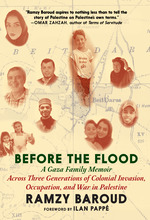
The images on this book’s cover attempt to honor some of the faces of those lost in the genocide. But no single cover could ever contain all the innocent lives that were extinguished. Even if such a space existed, entire families have been obliterated — burned away with their photo albums. And yet, their beautiful faces, their warmth, and their stories remain etched in our hearts forever.

The photographs chosen here are intimately tied to the lives portrayed in this book — including Ehab, the central character, and members of his immediate al-Badrasawi family, who were killed in harrowing succession, one after the other, before his own death and continuing still. Among them is my sister Soma, the beloved doctor of Khan Younis. Her murder is not only a tragedy — it is a rupture that runs through the very center of my family’s story, marking even the chapters yet unwritten, for generations to come.

As I turned to my final task of writing the introduction, I wanted to situate the book in what I believe to be the proper historical context. I have always argued that it was not the Balfour Declaration of 1917 that injected my people into the world’s historical discourse; it was not Israel that made us relevant by ethnically cleansing the Palestinians in 1948. But I struggled to define the single most critical event in our history, if any existed, that could serve as the starting point of our historical trajectory. This is when my sister Soma, one of Gaza’s most beloved medical doctors, was assassinated by the Israeli army on October 9, 2024, while on her way back from Al-Nasser Hospital in Khan Yunis. I say assassinated because she was the 166th doctor and 987th medical worker to be deliberately killed by Israel up to that date, part of the Israeli plan to annex our land and dismantle all aspects of Palestinian life and societal continuity.

After days of mourning, it dawned on me that Soma, in her beauty, cleverness, wisdom, patience, and, yes, courage and sacrifice, had always represented the single moment that demarcated the history of our people. Soma, or the representation of all the Somas of our history — including the history yet to be written — gives us meaning, inspires us, and grants us hope and courage.

Benny Morris, a devout Zionist himself, is right to observe that “Palestinians look at everything from a broad, long-term perspective.” Indeed, we do, even if, at times, we are not aware of it. Perhaps this lack of constant awareness allows us to continue for generations on the long collective journey to defend our historical home and freedom.


1. Alessandro Manzoni, The Betrothed (London: R. Bentley, 1834). Digitized by Harvard University, April 27, 2006.

2. “Longue durée.” Oxford Reference. www.oxfordreference.com/view/10.1093/oi/ authority.20110803100114325.

3. Palestine Chronicle TV. “Speaking to Professor Richard Falk: On Palestine, Israel and International Law.” YouTube video. Posted September 22, 2020. www.youtube.com/watch?v=AMtVONP3_co.

4. Ofer Aderet, “‘Israel Will Decline, and Jews Will Be a Persecuted Minority. Those Who Can Will Flee to America’,” Haaretz, January 22, 2019, https://www.haaretz. com/us-news/2019-01-22/ty-article-magazine/.premium/israel-will-decline-and-jews-will-be-persecuted-those-who-can-will-flee/0000017f-e552-d9aa-afff-fd5a159f0000.

5. Antonio Gramsci, Selections from the Prison Notebooks of Antonio Gramsci (New York: International Publishers, 1971).


RAMZY BAROUD is a Palestinian author, historian, and academic whose work focuses on Palestinian history, liberation, and people's history. His books include Searching Jenin, The Second Palestinian Intifada, My Father Was a Freedom Fighter, The Last Earth, and These Chains Will Be Broken. His book, Our Vision for Liberation, co-edited with Ilan Pappé, brings together voices shaping the Palestinian struggle today. Baroud holds a Ph.D. in Palestine Studies from the University of Exeter and has taught mass communication at Curtin University. He is a Non-Resident Senior Research Fellow at the Center for Islam and Global Affairs (CIGA) at Istanbul Zaim University. His academic contributions extend to numerous books and journals, and he has lectured at leading universities worldwide. His work has been translated into multiple languages, solidifying his role as a key voice in documenting Palestinian history and resistance.

I have no idea which words will come to me. I have no idea where my writing will take me. I would like to stall this moment and remain in a state of expectancy. Maybe I’m afraid that the act of writing will shatter this vision, just like sexual fantasies fade as soon as we have climaxed.